

About the Project
Organizational Unit
XXX
Management
Prof. Dr. Lena Keller
Project Number
01IF23037N
Research Area
XXX
Grant Program
Industrial Collaborative Funding (Federal Ministry for Economic Affairs and Climate Action) through the Research Association of the Food Industry (FEI)
Category
XXX
Duration
Background and project objective
In winegrowers' cooperatives and wineries, reliable and rapid analysis of incoming batches of grapes is essential today. Ideally, a sample is taken from the grape or mash container before unloading and analyzed for sugar and acid content as well as rot indicators using Fourier transform mid-infrared (FT-IR) spectroscopy. If the measurements indicate that the degree of rot in the grapes is too high, this can lead to deductions in the payment or even the rejection of entire batches of grapes. At the same time, the values provide important information for further winemaking. A major disadvantage of the established FT-IR spectroscopy is the indirect measurement method, in which FT-IR spectra are correlated with the reference analysis using a statistical model. This often leads to incorrect results. Nuclear magnetic resonance (NMR) analysis offers many advantages in this respect, as it measures the chemical species directly without the need for special sample preparation. It therefore provides very reliable quantitative results without the need for complex specific calibration in the relevant matrix such as must and wine. Until now, however, there has been a lack of inexpensive NMR measuring devices that can be used for mobile wine analysis. For some years now, compact benchtop NMR spectrometers have been available that meet these criteria.
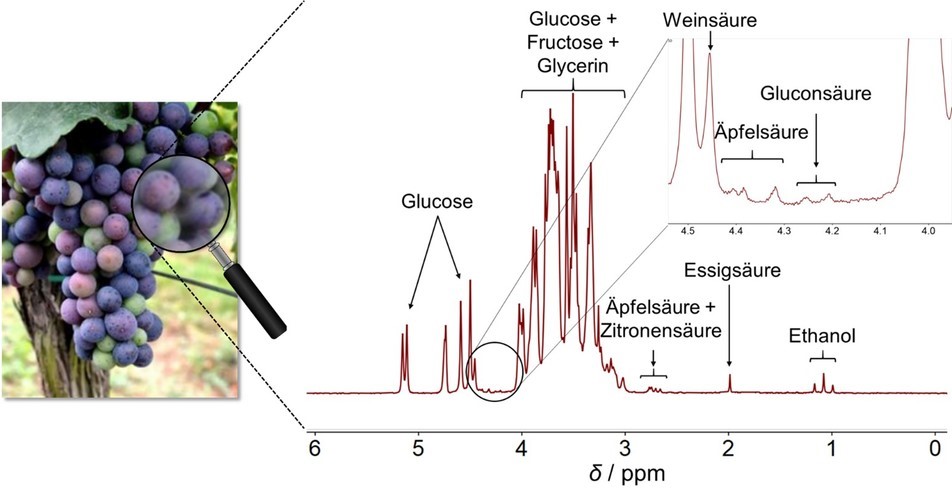
The goal of the project is to determine the most important quality parameters in must and wine using benchtop NMR analyses that are highly sensitive and legally admissible. To this end, a fully automated unit for must analysis is being developed. It consists of sample collection, sample preparation, and NMR measurement. The unit is intended for use in the grape reception areas of winegrowers’ cooperatives and wineries. The NMR spectra are automatically evaluated and enable the reporting of results in the form of concentration values for value-adding constituents and indicators of rot and varietal purity.
The research project is a collaboration with the Institute for Viticulture and Enology (Dr. Patrick Nickolaus, Prof. Dr. Ulrich Fischer) and the RPTU Kaiserslautern-Landau (project lead: Dr. Kerstin Münnemann).
Contact person
Contact us now!

Julian Lueck

Dr. Patrick Nickolaus

Prof. Dr. Lena Keller