

About the Project
Organizational Unit
XXX
Management
Prof. Dr. Lena Keller
Project Number
XXX
Research Area
XXX
Grant Program
Carl Zeiss Foundation
Category
XXX
Duration
Background and project objective
The use of carbonating cyanobacteria in biotechnological applications offers an alternative to the conventional use of heterotrophic bacteria, particularly in light of climate change and the industry’s shift toward greater sustainability and circularity. Thanks to their photosynthetic properties, cyanobacteria can be scaled up in a resource-efficient manner; they sequester CO₂ and produce a wide variety of substances of particular value. A few cyanobacteria form solid, crystalline shell structures containing calcium carbonate (CaCO₃), which show great potential for the production of hybrid materials such as light-conducting coatings or living, concrete-like building materials. Biological cementation via CaCO₃ precipitates is further enhanced by bonding with the cyanobacteria’s extracellular polymeric substances (EPS). The combination of biological cementation and bonding thus offers unique opportunities to impart new and, as needed, customized properties to hybrid materials and construction materials. This project aims to use cyanobacterial species to investigate the fundamental processes of cyanobacterial calcification and to utilize these processes to produce novel hybrid materials, such as (i) the production of a concrete-like, living building material with a positive CO₂ footprint (carbon capture) and (ii) light-conducting coatings that, for example, make solar cells more efficient.
The research project is a collaboration between Kaiserslautern University of Applied Sciences (Dr. Patrick Jung, Prof. Dr. Carina Lang) and Leibniz University Hannover (Prof. Dr. Georg Guggenberger, Dr. Stefan Dultz).
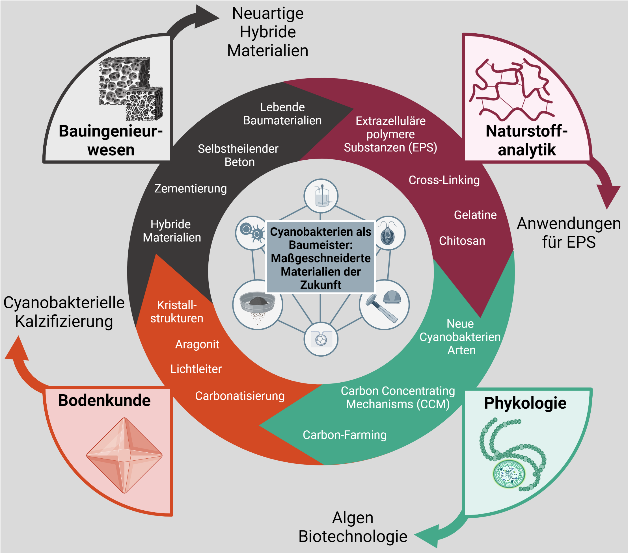
In a preliminary study, such a reinforced, living building material has already been developed, and its functionality now needs to be further enhanced. Key aspects of the hybrid materials—such as cementation, adhesion, light transmission, self-healing, and ductility—are to be modified with a view to optimization and the tuning of tailored properties. This will be accompanied by experimental approaches to optimize the living conditions of the cyanobacteria in order to maintain the functionality of the hybrid materials. Due to the complexity of the subject matter and the high degree of innovation, this work requires a highly interdisciplinary team that combines the fields of phycology, soil chemistry/mineralogy, polymer science, and civil engineering, with the ultimate goal of implementing cyanobacterial calcification as a new process in biotechnology.
Contact person
Contact us now!

Julia Hale

Prof. Dr. Lena Keller