

About the Project
Organizational Unit
XXX
Management
Prof. Dr. Lena Keller
Project Number
XXX
Research Area
XXX
Grant Program
Carl Zeiss Foundation
Category
XXX
Duration
Background and Project Objective
Wine and plant components of the Vitis vinifera grapevine have been used in medicine since ancient times. Today, many of the beneficial compounds—such as flavonoids, other polyphenols, and terpenoids—are known, but by no means all of them. Recent studies have demonstrated that products such as leaf, seed, and grape skin extracts possess potent antimicrobial properties against bacteria and fungi; however, there is often a lack of knowledge regarding which compounds are actually responsible for these effects. Yet it is precisely these compounds—also known as natural products—that serve as an ideal starting point for the development of new drugs. They are evolutionarily designed to penetrate cell walls and interact with biological macromolecules.
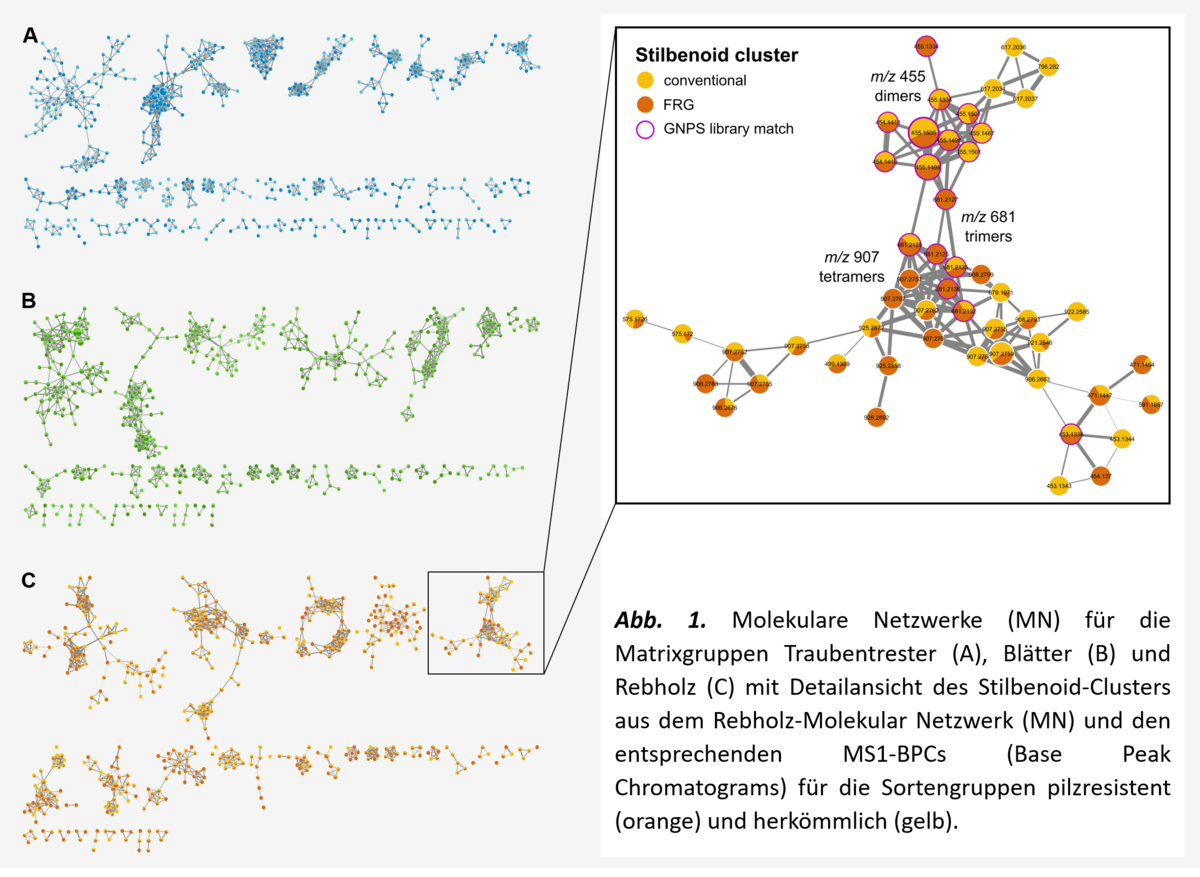
The research project aims to isolate and characterize the antimicrobial natural products from byproducts of wine production, thereby contributing both to natural product research and to the valorization of wine byproducts. To this end, samples of the wine byproducts are extracted and tested for their antimicrobial activity using a plate diffusion assay. Molecular networking, a method based on mass spectrometry, will be used to identify the active compounds. This technique is applied to visualize and evaluate similarities and differences in the chemical profiles of the samples, thereby enabling the bioactivity to be attributed to a specific compound or group of compounds. Subsequently, the bioactive natural compounds will be purified and characterized chemically and biologically. The selection of raw materials prioritizes sustainability and fungus-resistant grape varieties (= PiWi grape varieties). These offer advantages in terms of reduced pesticide use in viticulture and, potentially, an improved spectrum of natural compounds due to symbiotic microorganisms. Initial results show that the method provides new insights into the chemical properties and resistance mechanisms of the PIWI grape varieties.
Contact person
Contact us now!

Manuel Blank

Thomas Roos

Prof. Dr. Lena Keller