

About the Project
Organizational Unit
XXX
Management
Prof. Dr. Marc Dressler
Duration
2026–2028
Research Area
Transformation and Strategic Development of the Wine Industry
Pump Capacity
198,000 €
Partners
University of Hohenheim
Agricultural Management
Category
Agricultural Economics, Scenario and Land-Use Modeling
Grant Program
German Viticulture Research Association (FDW)
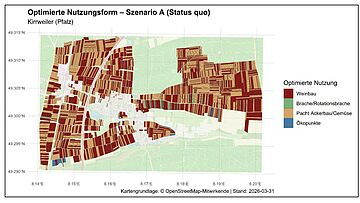
From Pressure to Conform to a Solid Basis for Decision-Making
Background and Project Objective
MoReb examines the adaptation of vineyard areas as an economic, spatial, and strategic structural issue.
Current Situation Declining wine consumption, economic pressures in parts of the production sector, and regional variations in site conditions are increasing the need for adaptation. Land abandonment and fallow land are already occurring, but often without a shared basis for information and decision-making. |
Project Objective MoReb is developing a spatially explicit economic model that integrates plot-specific data with market, location, and policy parameters. This allows for a comparison of different approaches to land-use adjustment in “what-if” scenarios. |
Benefits The goal is not to prescribe a single solution. The project provides transparency regarding conflicting objectives, impacts, and courses of action, serving as a scientific basis for decision-making by policymakers, associations, regions, and wine-growing operations. |
From Data to Decision-Making Knowledge
Methodology
Geodata-based modeling, economic scenario analysis, preference measurement, and stakeholder research are all interconnected.
| 1 |
Model & Data → Vintnery Records, Geodata, Age, Slope Gradient, Frost, Prices, Costs, Leases, and Protected Areas |
| 4 |
Scenarios → Price Changes, Premiums, and Political Conditions as "What-If" Simulations |
| 2 |
Profitability → Crop-specific yields, costs, and contribution margins under defined assumptions |
| 5 |
Reality check → DCE, interviews, stakeholder dialogs, and co-design assess acceptance, conflicting goals, and feasibility |
| 3 |
Land Use Options → Vineyards, fallow land, agricultural leases, ecopoints, and other alternatives |
Methodological Guidelines
Qualitative findings can inform model parameters and scenarios, explain and constrain model results, or remain as independent evidence. It is precisely this distinction that makes the basis for decision-making more robust.
Price trends have a noticeable impact; the premium changes the landscape
Current Project Status
Geodata-based modeling, economic scenario analysis, preference measurement, and stakeholder research are all interconnected.
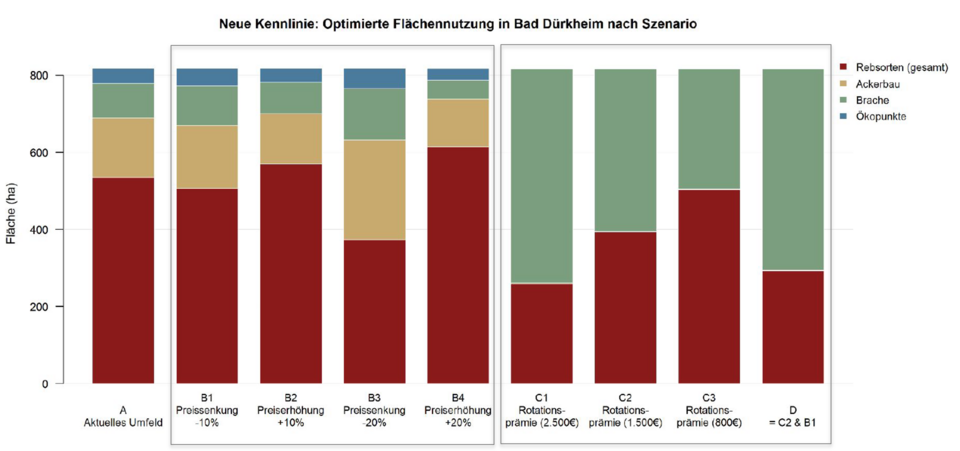
Price effects vary by region
Price reductions hit problem areas and high-risk locations particularly hard; positive price trends do not automatically make every plot of land profitable.
Premiums influence land-use decisions
Set-aside or rotation premiums can significantly shift optimal land use—depending on production structure and location.
Flexibility matters as much as the subsidy amount
The DCE interim analysis shows that program duration and land-use requirements strongly influence willingness to participate.
Next step: Model + reality check
The RLP model will be further developed and validated against operational, institutional, and qualitative evidence.
Wine Campus Neustadt and the University of Hohenheim Combine Complementary Research Expertise
| Wine Campus Neustadt · HWG Ludwigshafen → |
| Project management and economic/strategic research, qualitative research, stakeholder dialogue and knowledge transfer, integration of results into operational and industry-specific decision-making contexts. |
| MoReb → |
| Joint Research and Transfer Logic |
| University of Hohenheim · Agricultural Management |
| Expertise in economic and ecological land-use modeling, GAMS/GIS, and scenario analysis. Dr. Christian Sponagel oversees modeling, evaluation, and scientific collaboration. |
Contact Person
Project Team and Academic Collaboration
Prof. Dr. Marc Dreßler
Miriam Jäger
Research Collaboration · University of Hohenheim · Agricultural Management +49 711 459-22553 |
Interested in joining the project? Feel free to contact us. We look forward to receiving your application! |