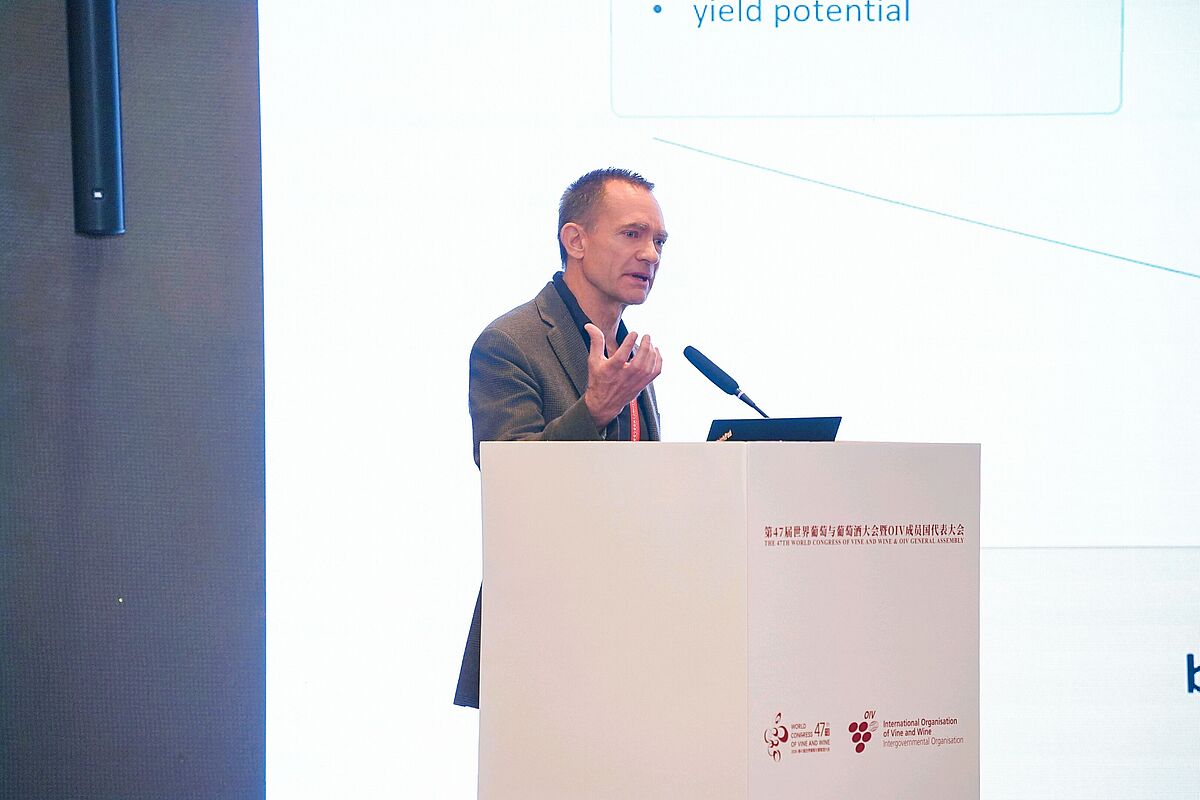
Prof. Dr. Marc Dressler at the 47th OIV World Congress in China: Presentation of Results from Ongoing Research Projects
Prof. Dr. Marc Dreßler presented the initial findings from the MoReb and GrapeBreed4IPM research projects at the 47th OIV World Congress on Vines and Wine in Yinchuan (China), presented the initial findings from the MoReb and GrapeBreed4IPM research projects
How can pesticide use in viticulture be reduced, thereby contributing to the goals of the European Green Deal? Prof. Dr. Marc Dreßler explained the potential solutions and the role that country-specific conditions play at the OIV World Congress on Vines and Wine. In the European research project GrapeBreed4IPM, Dreßler’s research team, together with international partners, is investigating the conditions for implementing integrated pest management strategies. One possible solution is the increased use of robust, fungus-resistant grape varieties (PIWI). The presentation featured findings from surveys of 605 wine-growing operations, 592 experts, and 5,282 consumers, as well as from six national design thinking workshops.
Declining revenues and varying site conditions raise a concrete question for winegrowing operations: Which vineyard plots can be cultivated economically in the future? Together with the University of Hohenheim, the Business Administration team at the Wine Campus Neustadt is pursuing two research approaches. A geodata-based model evaluates individual vineyard plots based on site conditions, production costs, revenues, and potential alternative land uses. The modeling is conducted for Bad Dürkheim and Kirrweiler; the current framework covers cask wine production over five years without new plantings.
Under various price and subsidy scenarios, the economically preferred land uses differ significantly. The subsidies examined are illustrative model assumptions and do not constitute recommendations for specific subsidy amounts. A supplementary discrete choice experiment involving 197 winegrowing operations examined the conditions under which hypothetical land-reduction programs appear attractive. Financial incentives play a role, while longer commitment periods and restrictions on subsequent land use reduce the willingness to participate. The study captured preferences in decision-making situations, not actual decisions to grub up vineyards. The analyses presented here represent an interim report from the ongoing MoReb research project.