

Organizational Unit
XXX
Management
Prof. Dr. Maren Scharfenberger-Schmeer
Project Number
HORIZON-MSCA-2023-DN-01-01
ID: 101168618
Category
XXX
Duration
The Spoil Control project is a large-scale research initiative carried out as part of a Marie Skłodowska-Curie project, with participants from no fewer than ten different European countries! Through Marie Skłodowska-Curie projects, the European Union aims to specifically promote the international and cross-sectoral careers of scientists, make Europe a more attractive destination for research, and create a strong pool of European researchers.
Europe has long held a leading position in the production and export of fermented beverages (wine, spirits, beer, etc.) and is one of the largest exporters of these beverages. However, the competitiveness of the European sector is increasingly being called into question. Microbial spoilage, defined as damage caused by microorganisms, represents a growing problem in the beverage industry. Beverages with negative sensory characteristics result in economic losses worldwide.
The Project SpoilControl will train the next generation of young researchers in the field of sustainability in fermentation technologies who will be able to address current and future challenges arising from microbial spoilage and contribute to the global improvement of the quality and safety of fermented beverages. To this end, there are fifteen individual research projects featuring strong collaborations and cross-sectoral, interdisciplinary approaches. With significant industry involvement, four work packages will analyze and gain a deeper understanding of spoilage microorganisms in beverages as they occur in real-world settings and investigate solutions for their detection and treatment.
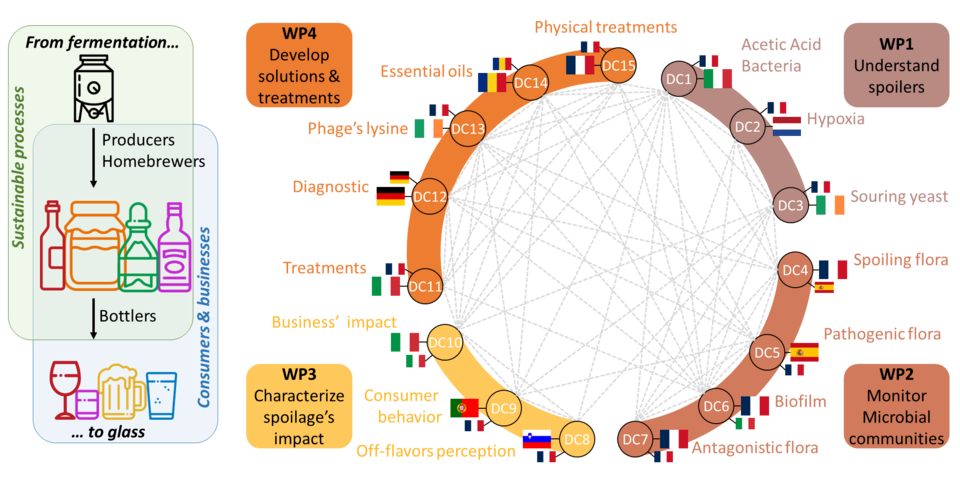
The objectives at the Wine Campus Neustadt (see Figure DC12) in Prof. Dr. Maren Scharfenberger-Schmeer’s research group focus on the development of an efficient, reliable, cost-effective, and universal analytical method (i.e., applicable to multiple beverages) that enables the early detection of harmful microorganisms primarily responsible for the spoilage of fermented beverages.
These are mostly acetic acid and lactic acid bacteria. Although there are various analytical methods for monitoring harmful microorganisms during the production process, they are generally too expensive for SMEs (small and medium-sized enterprises).
This objective is being pursued at the Wine Campus by a doctoral student who will work closely with all organizations involved in this subproject to find innovative solutions. In addition, a two-month secondment to Immundiagnostik AG is planned; the company is working on the development of a smartphone-based app for the detection of harmful microorganisms. This project will begin this fall.
SpoilControl will raise awareness of safety issues related to fermented products and promote hygiene practices to limit microbial spoilage for all end users, including producers, citizens, and homebrewers.
The research project is funded as an international, cross-sectoral doctoral program by the EU. Kaiserslautern University of Applied Sciences, along with the Wine Campus Neustadt (Prof. Dr. Scharfenberger-Schmeer), is part of this Marie Skłodowska-Curie (MSCA) network, which is a central component of the EU’s Framework Program for Research and Innovation, Horizon Europe.


Hafiza Mariam Waheed