
Organizational Unit
XXX
Management
Prof. Dr. Maren Scharfenberger-Schmeer
Project Number
AiF 20964 N
Research Area
XXX
Grant Program
Funding from the Joint Industrial Funding Program (Federal Ministry of Economics and Technology via AiF) through Dechema e. V.
Category
XXX
Duration
Against the backdrop of climate change and rising population density, issues such as sustainability and food security are becoming increasingly critical. This underscores the growing importance of reliable process control to prevent waste resulting from failure to meet specifications or regulatory requirements. This is of the utmost importance, particularly for small and medium-sized enterprises (SMEs), as the additional financial losses resulting from such issues cannot be tolerated given an already difficult competitive environment. Wineries in Germany consist primarily of precisely such SMEs. The goal of the AiF project was therefore to develop a cost-effective photometric analysis system for use in wineries. In addition, the project aimed to develop simple, cost-effective analytical methods for use in the wine cellar.
The goal of the project is to use smartphone photometry to detect and evaluate parameters such as acidity, color, sugar, alcohol, SO₂, as well as total phenols and protein stability. In the field of microbiology, the analysis of live bacterial counts is planned. An application in the area of raw material control is also conceivable.
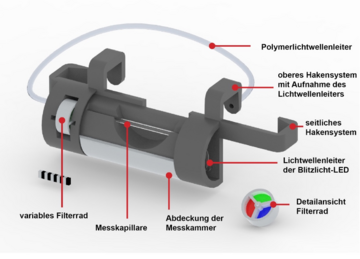
As part of the project, a portable photometer was developed that can be manufactured cost-effectively by combining light-emitting diodes (LEDs) as the light source and a phototransistor as the sensor. Flexible use of the measuring device is ensured by placing the optical elements on interchangeable circuit boards. The developed measurement circuit guarantees precise measurements. The intuitive operation of the measuring device, as well as the ability to implement various measurement protocols, is ensured by the accompanying smartphone app. The app enables parameter-specific integration of measurement procedures and evaluation functions.
Various measurement protocols were developed (or further refined) for wine analysis. First, a method was developed to represent the color of red and white wine in the CIE L*a*b* color space. A calculation was implemented that, based on individual measurements, enables the calculation of the transmission spectra of wine and subsequently the color coordinates in the CIE L*a*b* color space. In this context, color determination according to Glories and the correlation of both color determination methods with human perception were also investigated. Furthermore, with the help of machine learning, a model was developed to distinguish Blanc de Noir from rosé and white wine.
To determine the crystal stability of wine, measurement protocols for calcium and potassium concentrations were adapted, further developed, and optimized for use with wine. The same process was carried out for iron, total phenol, and sulfur content, which is related to the oxidation potential. The device’s suitability for use as a nephelometer was validated by measuring turbidity during the Bentotest.
Since microbiological parameters are also of great practical importance, these were also investigated during the course of the project. For example, a method for the early detection of malolactic fermentation was developed, which allows for predictions up to two days in advance. No photometric measurement method had previously been developed for this purpose.
As a result, a portable photometer was developed during the course of the project that, due to its small size, high sensitivity, and flexible application, is suitable for use in wineries. Thanks to the implementation of an app, the measuring device is also suitable for complex measurement routines. Its suitability for complex matrices such as wine was demonstrated using various parameters, though its applications are not limited to these. The measuring device thus offers promising prospects for the implementation of cost-effective yet precise process control in the wine industry and beyond.
The research project is being carried out as a collaborative project with Prof. Dr. Dominik Durner and the University of Kaiserslautern (project leader: Prof. Dr. Roland Ulber).

Anja Moraru