



TRADITION 1890
Riesling, 2025
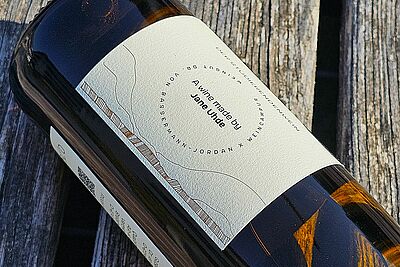
A wine made by Jane Uhde
In collaboration with the Bassermann-Jordan Winery
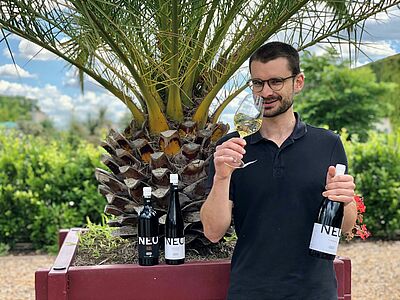
Traditional Riesling: As early as 1890, winemakers added grapes from other varieties to the Riesling must during fermentation to make the wine more fragrant. For my Riesling, I drew inspiration from this tradition: to enhance the aroma and depth, I added 2% whole Muskateller grapes.
While the Riesling brings a lively acidity, the Muskateller contributes a complex bouquet that is noticeably fragrant. On the nose, the wine reveals aromas of ice candy and honeydew melon, complemented by subtle floral notes from the Muskateller. On the palate, the Riesling’s lively acidity comes through. Notes of citrus fruits lend the wine an elegant structure.
Above all, my Riesling should be fun, easy to drink, and yet exude elegance. My goal is to convey a feeling reminiscent of a warm summer day after a rain shower: fresh and invigorating.
Notes of citrus fruits • yellow stone fruits
ON THE LEES
Chardonnay, 2025
A wine made by Viktor Rapp
In collaboration with the Sitzius Winery
This Chardonnay was produced in the fall between my 4th and 5th semesters of college. Back home on the estate, our Chardonnay vineyard is located on a high plateau called “Rosenberg,” on terraced gravel soils above the town of Bad Kreuznach on the Nahe River. Thanks to the cool, wind-exposed location, healthy grapes grow there that are ideal for fruit-forward, light wines—the classic cool-climate style.
After the harvest at dawn, the cool grapes were left to “macerate” as a mash for 24 hours to extract plenty of aromas. After gentle pressing, the must was fermented in a single-piece oak barrel (1,200 L) with selected yeasts. The oak barrel allows for slight oxidation, which rounds out the wine and allows it to mature slowly. Stirring the lees several times after fermentation imparts a slightly creamy to yeasty note and gives the wine depth and character. This is the origin of the name ON THE LEES, which translates to “on the lees.”
LONDON DRY GIN
London Dry Gin, 2025
A Gin made by Anna Plorin
In cooperation with the DLR Rural Area Service Center (DLR) Rhenish Palatinate Fruit Growing Research Station
As part of her bachelor’s thesis, student Anna Plorin created twelve different gins and analyzed the effects of aging in different types of wood. These included Austrian oak, Slavonian oak, chestnut, acacia, and cherry wood. Barrel aging influences the sensory profile of gin in different ways depending on the type of wood. Barrel aging imparts a unique character to gin depending on the type of wood. Oak wood provides balanced, pleasantly woody aromas and highlights the gin’s natural spiciness. Chestnut wood produces the most intense woody aromas and is associated with warm, autumnal, and nostalgic impressions. Acacia wood primarily affects the color, giving the gin a striking golden-yellow hue without significantly altering its aroma. Cherry wood, on the other hand, can produce medicinal-like notes that negatively impact the sensory experience. Research also shows that the effect of wood aging depends heavily on the specific gin recipe: floral gins harmonize particularly well with oak and chestnut, while herbal gins can benefit from aging in acacia wood.
“Air/Water” recipe: notes of citrus • medicinal/glue-like
“Fire/Earth” recipe: herbaceous • spicy • floral • ethereal • woody • resinous
TABULA RASA
Pinot Noir, 2023
In cooperation with the St. John State Winery and Johannitergut Neustadt
This unusual Pinot Noir was vinified as a dense, intense fortified wine by halting fermentation through the addition of alcohol. This strategy is commonly used in port wine production, for example. In this case, it was applied to a 2023 Pinot Noir, which was then aged for nearly two years in a small wooden barrel. The wine is perfect as an aperitif, dessert wine, or an unusual pairing with a meal.
Dried plum • Figs • Walnuts • Honey • Sour cherry • Orange zest • Caramelized walnut • Allspice • Nutmeg
VIE EN ROUGE
Blend: Syrah and Cabernet Sauvignon, 2023
In cooperation with the St. John State Winery and Johannitergut Neustadt
A co-fermented blend, including Syrah and Cabernet Sauvignon, modeled after the style of Côtes du Rhône wines. The 2023 vintage was allowed to age and develop until spring 2025 after fermentation was complete. To this end, it was aged in a used barrique barrel. The repeated use of the barrels alters the aromas that are imparted to the wine. At first, intense woody and toasted aromas predominate; as the barrels age, these aromas gradually diminish.
Compared to aging in stainless steel tanks, however, the wines often appear warmer, more mature, and more open, due to the increased gas exchange through the wood of the barrel. Even now, the Vie en Rouge still has aging potential and can be stored without hesitation until it’s ready to be served. If opened soon, it benefits from being decanted.
On the palate, the wine is lighter and more elegant than the nose initially suggests. Fresh, spicy, and with a pleasant tannin structure, the Vie en Rouge is ideal both as a dining companion and on its own.
Dark berries such as elderberry • pepper • violets • licorice • dark chocolate
PIONEER
Orange Wine, 2022
In cooperation with the St. John State Winery and Johannitergut Neustadt
A cuvée made from various white PIWI grape varieties. Of course, these healthy grapes are also meant to produce magnificent wines. The pioneering Orange Wine proves that this works wonderfully. The 2022 vintage aged on its fine lees until early summer 2025 and now impresses with its longevity and freshness.
Half of the grapes were fermented on the skins, while the other half were fermented spontaneously as must. This is the origin of the “orange” part of the name, which refers to white wines that—similar to red wine production—were fermented not as juice but as whole grapes or berries. A pleasant acidity prevents the wine from tasting too opulent despite its creaminess and, together with subtle phenolic notes, lends it length.
The Pionier orange is a wonderful dining companion that evolves after the bottle is opened, remaining exciting throughout the evening.
Honeydew melon • quince • orange zest • butter caramel • dried apricots • figs • thyme • sage
LAUROT
Laurot, 2022
In cooperation with the St. John State Winery and Johannitergut Neustadt
Laurot is a representative of the PIWI grape varieties. Fungus-resistant grapevines (PIWI) are considered sustainable and environmentally friendly because they exhibit remarkably high resistance to major fungal diseases. With these forward-looking qualities, this trailblazer fits perfectly into the NEO wine line!
After the harvest in fall 2022, the small, blue-black berries were fermented on the mash for 7 days and gently pressed. The young wine was then transferred directly to barrique barrels. After more than a year of aging in wooden barrels, the wine was filtered and bottled.
With our “NEO Pioneer,” this new grape variety is presented as a single-varietal wine—without any blend of other grapes. Deep and dark in color, its flavor lies between that of St. Laurent and Merlot red wines. It pairs wonderfully with mildly spiced grilled dishes, roast beef or lamb, full-flavored cheeses, or even dark chocolate.
Spicy wild berry aromas • pronounced blueberry notes with a soft tannin structure
VIE EN ROSE
Rosé, 2021
In cooperation with the St. John State Winery and Johannitergut Neustadt
This 2021 vintage rosé is a perfect blend of 90% Pinot Noir and 10% Cabernet Sauvignon grapes, which blend harmoniously together. The battonage process gives the wine a light smoothness and a creamy texture. The nose is dominated by raspberry notes, accompanied by subtle fruit aromas. The palate is refreshed by a crisp acidity that makes the wine lively and refreshing. The use of staves during aging imparts a subtle woody note, adding an extra layer of complexity to the wine. Overall, this rosé is an elegant and well-balanced wine that pairs perfectly with light dishes such as salads or fish. A wonderful wine to enjoy outdoors on a sunny day!
FUMÉ
Sauvignon Blanc, 2020
In cooperation with the St. John State Winery and Johannitergut Neustadt
Sauvignon Blanc is in a class of its own! The Sauvignon Blanc grape has long enjoyed international recognition, and although it has only been cultivated here for a few decades, it is full of surprises. The wine was pressed from whole grapes and allowed to mature for a full nine months on its lees in wooden barrels. Thanks to careful bâtonnage—the process of repeatedly stirring the lees—the NEO Sauvignon Blanc Fumé develops creamy and fruity aromas.
But what does “Fumé” actually mean? Translated from French, “Fumé” means “smoked.” The term “Fumé” originally comes from the Loire region. There, flint stones produce sparks and smoke when struck against a metal-bearing rock. Thus, the term “Fumé” primarily refers to the wine’s French origin. The combination of fresh acidity and creaminess is not only intriguing but also incredibly enjoyable.
Gooseberry • Passion fruit • Mango • Pineapple • Grapefruit • Vanilla
BRUT
Pinot Blanc, 2019
In cooperation with the St. John State Winery and Johannitergut Neustadt
The NEO Pinot Blanc Brut is not only a highly intriguing sparkling wine, but it has also expanded the NEO wine portfolio to include sparkling wines. Most wine lovers have long known that Pinot Blanc can be used to produce more than just excellent wine. Our NEO Pinot Blanc Brut also surprises wine fans with its lively character.
The NEO Pinot Blanc Brut spent an entire year in barrique barrels, allowing its complexity of flavor and aroma to fully develop. After nine months in the bottle, it was finally transformed into sparkling wine. Not only does its orange-yellow color with greenish highlights create anticipation in the glass, but so does its fresh aroma with its distinctive woody notes.
The NEO Pinot Blanc Brut offers an excellent opportunity to enjoy a unique yet well-rounded taste experience. Added to this is a lively acidity that balances beautifully with the creaminess. With no residual sugar whatsoever, the NEO Pinot Blanc Brut is nonetheless avant-garde, challenging, and modern. The long finish, rich with brioche notes, is carried by a fine perlage.
Pear • yellow apple • vineyard peach • apricot
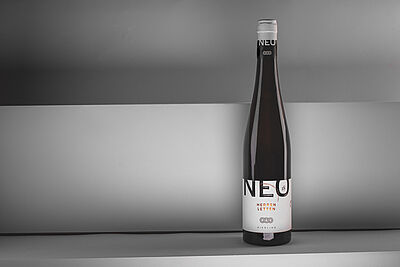
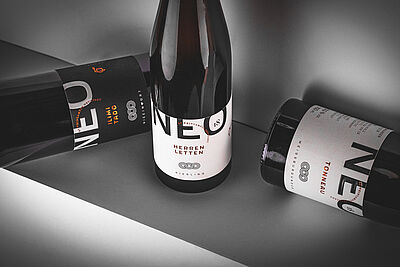
HERRENLETTEN
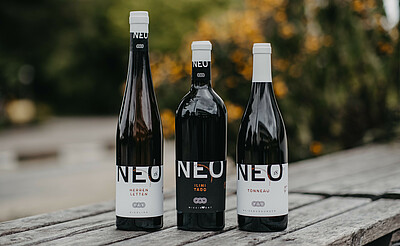
Riesling, 2018
In cooperation with the St. John State Winery and Johannitergut Neustadt
This German white wine grape variety comes from one of the best vineyard sites in the greater Neustadt area, the Haardter Herrenletten. On this perfectly sloped site, the grapes ripen at an elevation of approximately 160 meters above sea level on loamy and marly clay soil, thus enjoying optimal growing conditions. The oak is perfectly integrated into the flavor—a classic, dry Riesling from the Palatinate.
Peach • passion fruit • apricot • ripe apple • vanilla
TONNEAU
Pinot Blanc, 2018
In cooperation with the St. John State Winery and Johannitergut Neustadt
Over the past two decades, the vineyard area planted with the Weißburgunder variety has nearly tripled, making it one of the top four varieties in Germany today. Our NEO Weißburgunder is a real standout. Aged entirely in a tonneau—a 500-liter oak barrel—and matured for eight months until bottling, the oak influence comes through more intensely here. The grapes for this wine were harvested by hand, with students from the Wine Campus lending a hand. A true community project! On the palate, the Pinot Blanc is dense and velvety, with a nice touch of salinity.
Herbal meadow • Flint • Papaya • Hazelnut • Vanilla
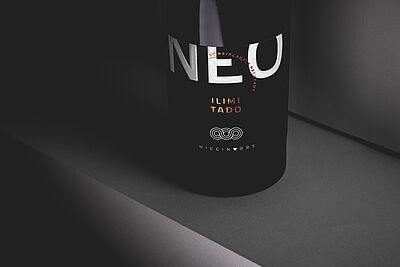
UNLIMITED
Sweet Wine, 2018
In cooperation with the St. John State Winery and Johannitergut Neustadt
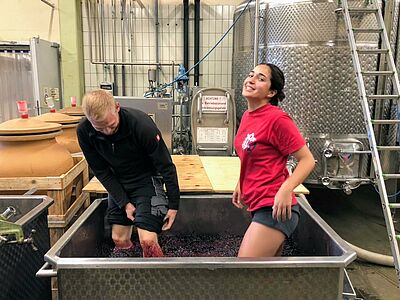
The Ilimitado fortified wine is a classic blend of selected grape varieties. These varieties are typical of wine-growing regions in Southern, Western, and Central Europe, but they also thrive in our mild Palatinate climate. An exchange student from Porto assisted in the production process, teaching us the traditional Portuguese method for making port wine: grape treading. Three times a day for 20 minutes each time, the mash was worked using this punch-down method. As is customary with a fortified wine, the must was “fortified” during fermentation with high-proof wine distillate—in this case, a grape brandy—which stops fermentation and allows the fortified wine to retain a high alcohol and residual sugar content. The selection of grape varieties, the cross-border team, and the wine’s style give the NEO dessert wine its name, Ilimitado (Portuguese for “boundless”). The NEO Ilimitado has a good tannin structure and excellent aging potential.
Plum • Strawberry • Violet • Clove • Cinnamon
BLANC DE BLANCS
Pinot Blanc, annual cycle
As part of the sparkling wine internship in the 5th semester
In cooperation with the St. John State Winery and Johannitergut Neustadt
Every year, as part of the sparkling wine internship, a new vintage of the Blanc de Blancs NEO sparkling wine is produced, with students in their fifth semester learning two key steps in traditional sparkling wine production: First, the current base wine for sparkling wine is bottled to initiate the second fermentation; second, the sparkling wine bottled two years ago is disgorged and brought to completion.
For the Blanc de Blancs, Pinot Blanc grapes are vinified differently depending on the vintage and oenological objectives. This brings out the diverse expressions of this grape variety and allows the unique characteristics of each vintage to be experienced through the senses. The base wine produced from these grapes is mixed with the tirage in winter to initiate traditional bottle fermentation, then bottled and sealed with a crown cap. The carbon dioxide produced during the second alcoholic fermentation remains entirely in the bottle, forming the basis for the fine effervescence. Fermentation is followed by approximately two years of aging on the lees. During this maturation phase, autolytic processes within the yeast cells lead to the development of a fine and persistent perlage, as well as complex aromas with subtle yeast notes, a creamy texture, and remarkable elegance. The result is a sparkling wine full of character, with great finesse and a perfectly balanced dosage. In this way, each semester accompanies a vintage of NEO sparkling wine through a crucial phase of its development and, at the same time, brings to completion a sparkling wine whose development was prepared by the preceding students.