Friedrich Gennheimer Prize awarded for the first time
Ceremonial Presentation of the Friedrich Gennheimer Prize to Two Alumni of the Wine Campus Neustadt
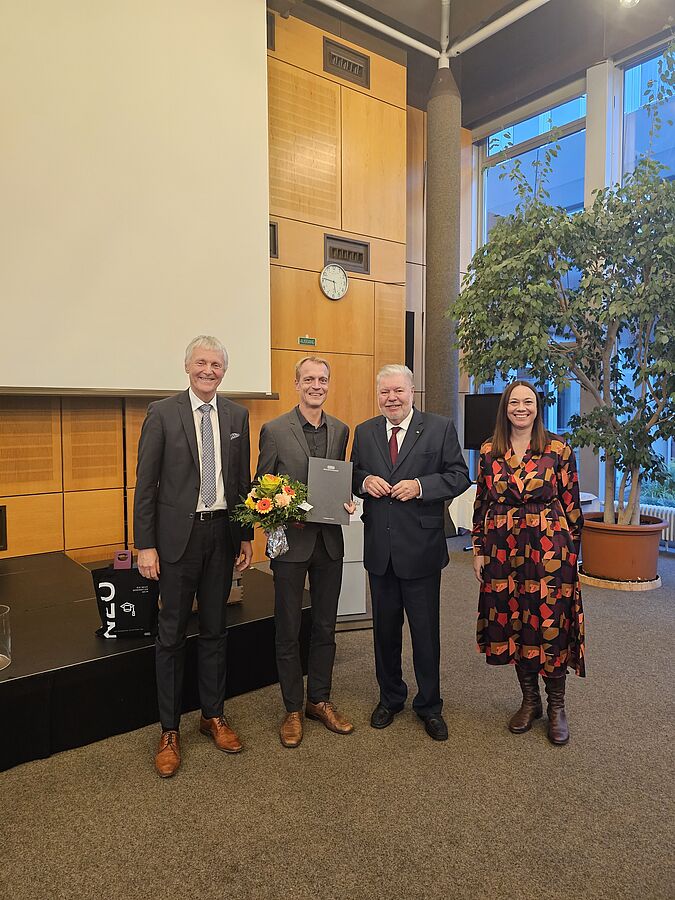
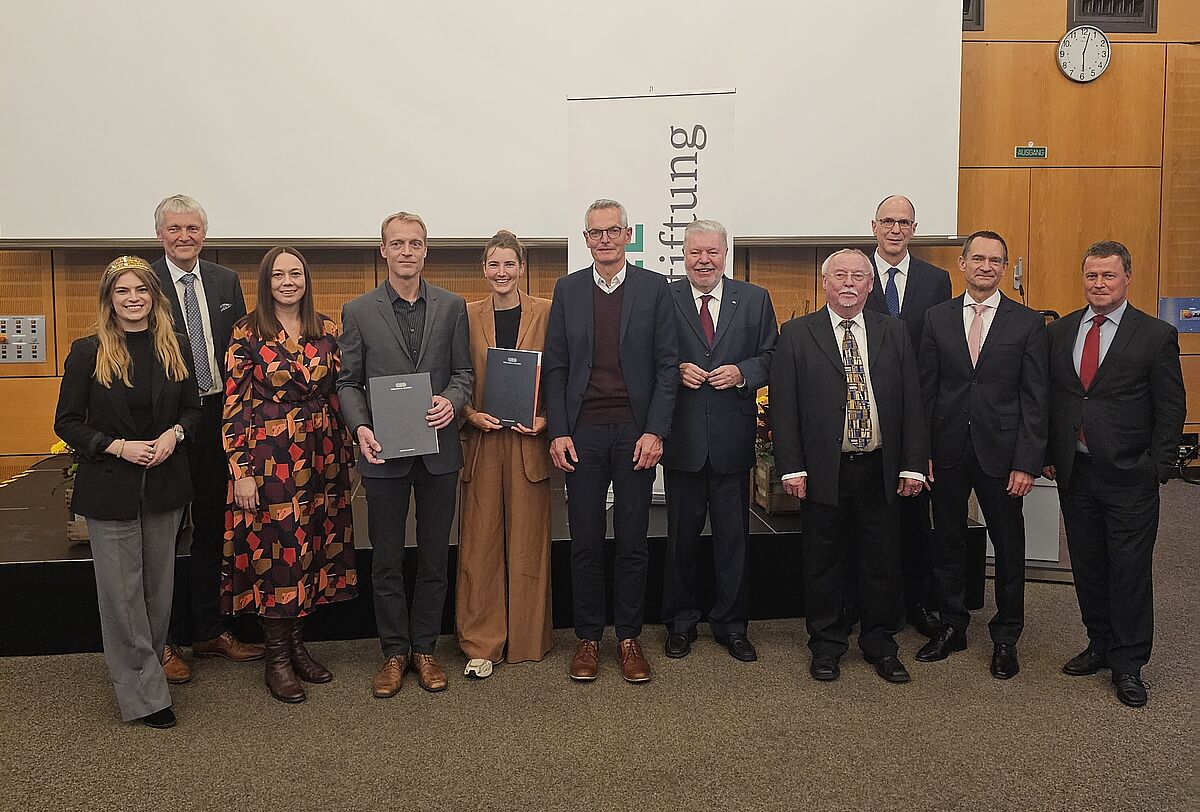
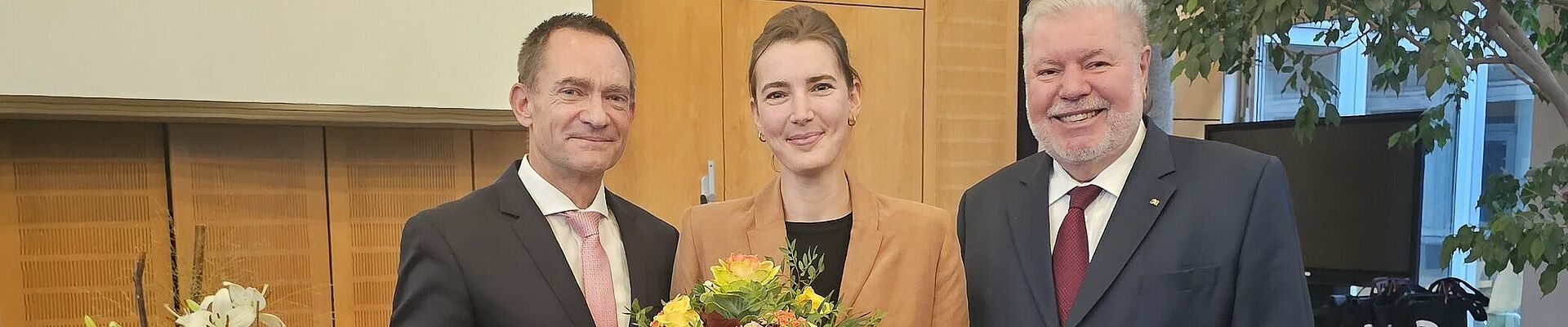
On Friday, October 27, 2023, the Haniel Foundation and the Ludwigshafen University of Business and Society presented the Friedrich Gennheimer Prize to two master’s students from the Wine Campus Neustadt. The award-winning master’s theses examine the economy’s transformation toward greater sustainability. The Friedrich Gennheimer Prize for Marketing, worth 3,000 euros, went to Pauline Baumberger-Brand. The Friedrich Gennheimer Prize for Viticulture, Enology, and Wine Marketing, worth 3,000 euros, was awarded to Martin Ladach.
In memory of Friedrich Gennheimer, the Friedrich Gennheimer Prize was established in 2023 in collaboration with the Haniel Foundation as the awarding institution. The Ludwigshafen University of Business and Society and the Haniel Foundation can already look back on 25 years of collaboration. Prof. Dr. Gunther Piller, President of the Ludwigshafen University of Business and Society, opened the ceremony for the presentation of the Friedrich Gennheimer Prize in the auditorium of the Service Center for Rural Areas (DLR) Rheinpfalz. “The Wine Campus Neustadt is a success story based on close collaboration among the three sponsoring universities—Bingen University of Applied Sciences, Kaiserslautern University of Applied Sciences, and the Ludwigshafen University of Business and Society—and the Rural Area Service Center (DLR) Rhenish Palatinate. The Friedrich Gennheimer Prize adds yet another powerful dimension to this success story.” Former State Secretary Dr. Siegfried Englert’s speech focused on Friedrich Gennheimer’s inspiring life. Englert is not only the executor of Gennheimer’s estate but also one of the co-founders of Wine Campus Neustadt.
Kurt Beck, former Minister President, delivered the evening’s keynote address: “We have gathered here today to honor the extraordinary achievements of young people. This is more important than ever in today’s world. Even if the scientific findings developed at universities may not always be the be-all and end-all, we should always take them into account. Universities are places where solutions are developed. Which grapevines are sustainable? I think it’s important—and I’d like to emphasize this—that scientific findings be presented in an accessible way.” In his speech, Beck addressed the holistic perspective on sustainability: “Sustainability must be implemented not only in a societal context but also in a personal one. To be able to view things in their entirety, one must also be open to doing so.”
Pauline Baumberger-Brand, a graduate of the MBA Wine, Sustainability & Sales program, focused her master’s thesis on a workshop format for sustainability development in the German wine industry. The format is designed to facilitate the process of change initiated through interaction. Her emotional acceptance speech highlighted how important the sustainable development of wineries is to her and how much her studies at the Wine Campus Neustadt meant to her. Prof. Dr. Marc Dreßler, program director of the MBA Wine, Sustainability & Sales, expressed his pride in his laudatory remarks. “Ms. Baumberger-Brand is not only a scientifically grounded and intrinsically driven individual, but also a very open-minded person. She recognizes the need for action in the field of sustainability and understands the complexity associated with this often overused term. Ms. Baumberger-Brand is an entrepreneur herself, and her master’s thesis impresses with its many practical applications,” said Prof. Dreßler in his laudatory speech.
Martin Ladach, a graduate of the German-French master’s program in Viticulture & Enology, examined fungus-resistant grape varieties in his master’s thesis to determine their suitability for the production of white wines using the maceration fermentation method. Four aging variants were tested for each grape variety. The mash fermentation method proved particularly suitable for the Sauvignac, Muscaris, and Cabernet Blanc varieties. In addition to enabling environmentally friendly and sustainable viticulture, all of the grape varieties studied show great potential for defensive Enology. Prof. Dr. Ulrich Fischer, Director of the Institute of Viticulture and Enology, delivered the laudatory address: “Martin Ladach is a pioneer and trailblazer who has a great passion for wine. At the Wine Campus Neustadt, robust scientific data is generated. Martin Ladach’s master’s thesis lays the foundation for sustainability in viticulture and truly makes wineries more future-proof. PIWIs are fascinating and can help winemakers save time and money.”
Friedrich Wilhelm Gennheimer was born in 1930 in Neustadt an der Weinstraße. The Gennheimer family is well known in Neustadt under the business name Gebrüder Gennheimer Sektkellerei. His professional career began with a degree in business administration, which he completed with a Diplom-Kaufmann degree. This was followed by a teaching position in general business administration at the vocational schools in Speyer, as well as a transfer to the State Higher School of Economics in Ludwigshafen, where he also taught business administration. Just one year later, he was appointed professor at the Rhineland-Palatinate University of Applied Sciences in the Ludwigshafen campus. Gennheimer taught there in the fields of marketing, human resources, and vocational training. From 1979 to 1987, he served as dean of the Ludwigshafen campus and was responsible during this period for establishing the Worms campus as well as the East Asian Institute in Ludwigshafen. Gennheimer retired in 1996, though he continued to teach as an adjunct professor in the Department of Business Administration in the years that followed.
Friedrich Gennheimer passed away in 2022, leaving a portion of his estate to support outstanding graduates of the Ludwigshafen University of Business and Society in the fields of viticulture and marketing. Prof. Dr. Laura Ehm, professor of marketing at the Wine Campus Neustadt, is the lead coordinator for the collaboration with the Haniel Foundation and the Ludwigshafen University of Business and Society: “I am very pleased that we can honor excellent theses with such a generously endowed prize and that funding for this will be available for the next ten years.”
Image credits: Wine Campus Neustadt